


Green Science Alliance Proposes New 3D "Jungle Gym like" Structure for Solar Power Generation
KAWANISHI-CITY, Japan, Dec. 2, 2025 /PRNewswire/ -- Dr. Ryohei Mori of Green Science Alliance Co., Ltd. - a company engaged in the research and development of cutting-edge environmental and energy technologies for decarbonization and building a carbon-neutral society—has proposed a new solar power generation system utilizing a 3D "jungle gym" structure, with proof-of-concept testing planned in the near future.
Large-scale solar installations ideally require flat, open geographic feature, but Japan's limited supply of such land forces developers to promote deforestation to accommodate these facilities. Beyond the fundamental irony of destroying CO₂-absorbing forests in pursuit of carbon reduction goals, this approach creates serious environmental and social problems. Extensive deforestation destroys habitats, severely impacting ecosystems, while also reducing the ground's natural water retention capacity, increasing the risk of landslides and flooding. Scenic landscapes also suffer from the installation of unsightly mountainside farms. These issues often leads to conflicts with local residents and brought forest-clearing mega-solar development into the national spotlight as a significant policy issue.
Such mega-solar facilities are powered by arrays of silicon solar cells. While there are numerous types of solar cell technologies in various stages of development and deployment—including compound-based, perovskite, organic thin-film, and quantum dot cells—it is silicon-based solar cells that are most widely used in the global mega-solar market.
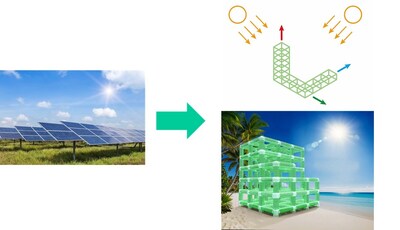
Silicon solar cells that dominate current installations must be oriented directly toward the sun. Their dark and opaque structure prevents light from transmitting through, precluding any possibility of power generation on the opposite side. Furthermore, silicon cells are generally rigid and inflexible, implying that solar arrays can only be expanded in two dimensions. (Some amorphous silicon variants allow slight curvature, but their bending angles are insufficient to overcome this fundamental limitation.) The need for vast planar arrays is the driving force behind the large-scale deforestation and other associated problems described above.
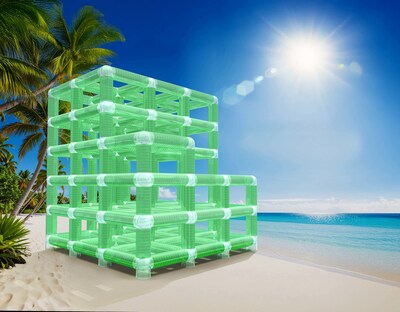
Organic thin-film solar cells offer solutions to these limitations of conventional silicon-type cells. With suitable materials, they can be made semi-transparent or even fully transparent, allowing sunlight to pass through the first layer and reach additional photovoltaic cells below. They are also flexible, allowing the power-generating surface to capture sunlight from various angles in three-dimensional space. Building on these properties, Dr. Ryohei Mori has conceived a 3D solar array in which organic thin-film cells are wrapped around the transparent pillars and struts supporting the structure, resembling a playground jungle gym. The array can expand both horizontally and vertically; if both the cells and supports were fully transparent, it could theoretically extend to any height. This approach would eliminate the need for vast planar installations and the deforestation associated with them.
This 3D approach also opens new possibilities for agrophotovoltaics, or "solar sharing," in which solar panels are installed above agricultural fields to allow simultaneous farming and power generation. The jungle gym structure can accommodate sufficient clearance for workers and farm equipment to operate freely beneath it, offering a novel spatial configuration for solar sharing operations. With improvements in transparency and photovoltaic efficiency, the 3D array could potentially deliver higher power-generation yields than conventional 2D silicon-based solar sharing installations, allowing electricity suppliers to operate more efficiently.
Green Science Alliance aims to complete a model prototype and begin proof-of-concept testing in early 2026. However, significant technical challenges remain: the organic thin-film solar cells currently under consideration have limited transparency, and their photovoltaic conversion efficiency is less than a half of conventional silicon solar cells. Because transparency and conversion efficiency depend heavily on the donor and acceptor materials used in organic thin-film solar cells, Green Science Alliance plans to pursue the synthesis and commercialization of advanced versions of these materials as part of its long-term development strategy. The company will also explore perovskite solar cells, whose transparency can be enhanced through structural optimization, as an alternative or complementary technology.
During the proof-of-concept phase, sunlight intensity is expected to diminish as it reaches lower layers of the structure due to the limited transparency of current organic thin-film solar cells. The company also plans to conduct simulation testing to evaluate multiple variables simultaneously, including solar irradiation intensity at different times of day, weather conditions, and seasons; light absorption by curved cell surfaces; power generation under varying conditions; and how electrical output is affected by different interconnection methods and circuit configurations.
Media Contact:
Ryohei Mori
09085282305
405591@email4pr.com
 View original content to download multimedia:https://www.prnewswire.com/news-releases/green-science-alliance-proposes-new-3d-jungle-gym-like-structure-for-solar-power-generation-302629176.html
SOURCE Green Science Alliance Co., Ltd.