


Canadian Public Safety Organizations Face Growing Challenges With NPSNet Policy, Finds Info-Tech Research Group
As Canadian law enforcement, justice departments, and public safety organizations continue to digitize operations, many still struggle with the ambiguity of the NPSNet Secured Communication Policy. Newly published insights from Info-Tech Research Group show that while organizations are expected to comply, they often lack the operational guidance, tools, and capacity needed to interpret policy requirements and demonstrate readiness for Net Connection Authorization Change/Request (NCACR) submissions. The firm's blueprint, Build a Security Compliance Program Aligned to NPSNet Policy With ITSG 33, provides a structured framework based on ITSG 33 Annex 3A to help organizations translate policy into action, assess compliance gaps, and strengthen NCACR readiness.
TORONTO, Dec. 15, 2025 /CNW/ - As Canadian police services, justice departments, and public safety organizations digitize operations and adopt cloud-based systems, the pressure to meet NPSNet Policy expectations has intensified. Despite having access to the policy, many frontline IT and security teams still face uncertainty when attempting to interpret high-level control language and apply requirements across hybrid, on-premises, and cloud environments. According to a newly published resource from global IT research and advisory firm Info-Tech Research Group, the lack of operational guidance results in inconsistent implementations, delayed NCACR submissions, and reduced confidence among reviewers and oversight bodies. The firm's blueprint, Build a Security Compliance Program Aligned to NPSNet Policy With ITSG 33, offers a precise and repeatable framework for organizations to structure compliance programs, map requirements, and prepare complete NCACR packages supported by auditable controls.
According to the findings in Info-Tech's blueprint, law enforcement and justice organizations often operate within fragmented systems and limited capacity, leaving IT and security teams to interpret expectations without shared standards. Compliance backlogs frequently occur when police organizations, municipalities, and vendors are not aligned early in the process. The findings show that these structural gaps increase the risk of misconfigurations, inconsistent control ownership, and delays that slow technology deployments and modernization efforts.
"Organizations are responsible for meeting federal-level expectations, yet they often lack the operational clarity needed to do so with confidence," says Vidhi Trivedi, senior research analyst at Info-Tech Research Group. "IT and security teams need a structured, repeatable framework that translates policy intent into concrete actions. A shared model grounded in ITSG 33 helps organizations standardize implementation, close control gaps, and demonstrate NCACR readiness through evidence that is both consistent and defensible."
Key Challenges Canadian Law Enforcement and Public Safety Organizations Face in NPSNet Compliance
Despite the importance of secure policing and justice data exchange, Info-Tech's blueprint reveals several systemic challenges that continue to hinder progress:
- High-level, classified policy language leaves organizations unsure how to configure and implement critical controls such as MFA, encryption, and identity federation.
- Limited internal capacity forces many police IT and security teams to balance daily operations with compliance documentation and NCACR preparation.
- Siloed governance models continue to create confusion around ownership and reduce coordination between police services, municipalities, justice departments, and vendors.
- Inconsistent interpretations across jurisdictions weaken audit confidence and prolong NCACR approval timelines.
Info-Tech's Structured Approach to NPSNet Alignment and NCACR Readiness
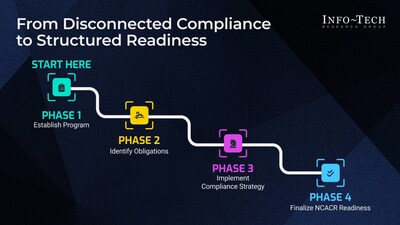
To address these challenges, the firm's Build a Security Compliance Program Aligned to NPSNet Policy With ITSG 33 blueprint outlines a phased and actionable approach that helps organizations move from reactive compliance efforts to a fully structured program:
Phase 1: Establish the Compliance Program
IT and security leaders begin by reviewing a control framework based on ITSG 33 and determining how it will be applied across their environments. Governance committees define roles, establish accountability, and identify which operational environments fall within NPSNet's scope. This provides the foundation for consistent interpretation and execution across police services, justice agencies, and municipal partners.
Phase 2: Identify Compliance Obligations
Compliance owners and legal teams work together to document all applicable requirements, including federal and provincial obligations, contractual expectations, and internal security standards. Leadership then determines conformance levels and maps these obligations to the organization's chosen control framework. This step gives IT teams clear direction on which controls must be implemented and at what level of rigor.
Phase 3: Implement the Compliance Strategy
Security leaders, policy owners, and technical teams collaborate to update policies, design control implementations, and align their compliance activities with the organization's broader security roadmap. Police IT teams embed required controls into daily operational workflows, ensuring that responsibilities are clear and actions are auditable.
Phase 4: Finalize NCACR Readiness
IT teams, system owners, and compliance authorities work together to complete focused NCACR gap analysis, verify maturity levels, and assign remediation tasks to the appropriate technical staff or operational units. Leadership plans and tracks initiatives using standardized templates that ensure all required evidence is complete, consistent, and defensible for NCACR submissions.
Info-Tech's blueprint also includes a full control framework, compliance management tools, gap analysis templates, NCACR readiness trackers, and step-by-step guidance to support Canadian law enforcement, justice, and public safety organizations. By applying the firm's structured methodology, these organizations can align with NPSNet expectations, improve consistency across jurisdictions, reduce delays in NCACR reviews, and strengthen the secure exchange of policing and justice information across Canada.
For exclusive and timely commentary from Info-Tech's experts, including Vidhi Trivedi, and access to the complete Build a Security Compliance Program Aligned to NPSNet Policy With ITSG 33 blueprint, please contact pr@infotech.com.
About Info-Tech Research Group
Info-Tech Research Group is one of the world's leading and fastest-growing research and advisory firms, serving over 30,000 IT, HR, and marketing professionals around the globe. As a trusted product and service leader, the company delivers unbiased, highly relevant research and industry-leading advisory support to help leaders make strategic, timely, and well-informed decisions. For nearly 30 years, Info-Tech has partnered closely with teams to provide everything they need, from actionable tools to expert guidance, ensuring they deliver measurable results for their organizations.
To learn more about Info-Tech's HR research and advisory services, visit McLean & Company, and for data-driven software buying insights and vendor evaluations, visit the firm's SoftwareReviews platform.
Media professionals can register for unrestricted access to research across IT, HR, and software, and hundreds of industry analysts through the firm's Media Insiders program. To gain access, contact pr@infotech.com.
For information about Info-Tech Research Group or to access the latest research, visit infotech.com and connect via LinkedIn and X.

SOURCE Info-Tech Research Group