


54% of consumers say tariffs are forcing personal spending cuts, Achieve survey finds
Americans report cutbacks and caution as tariffs threaten budgets and consumer confidence
SAN MATEO, Calif., Dec. 11, 2025 /PRNewswire/ -- Over half of consumers (54%) have already cut back or plan to reduce their nonessential spending as a result of tariff-related price hikes, according to the results of a new survey by Achieve, the leader in digital personal finance.
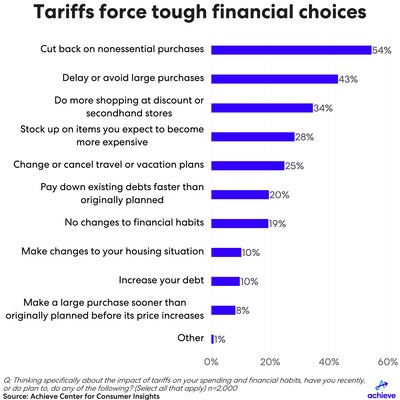
The survey was conducted by Achieve's think tank, the Achieve Center for Consumer Insights, and found that recent changes to U.S. tariff policies have moved from abstract economic news to an immediate trigger for belt-tightening for many households. Consumers expressed concern about increases in the already high cost of living and retailers' ability to keep everyday items in stock. Key findings include:
- Price pessimism: 67% of respondents expect the cost of groceries to worsen
- Reluctance to take on new debt: 59% say they are not likely to take on additional debt in the next six months.
- Retail supply strain: 57% believe tariffs will worsen retailers' and merchants' abilities to keep everyday essentials in stock.
- Household constraint: 44% expect tariffs to have a negative impact on their household budget
- Delayed large purchases: 43% of Americans are delaying or avoiding large purchases.
- Trouble making ends meet: 39% of respondents say recent tariff policy changes have made it harder to make ends meet, prompting concern that many won't be able to adapt financially if prices keep rising.
"These results point to a broader trend of financial caution and stress, particularly for the significant share of Americans operating on thin financial margins," said Achieve Center for Consumer Insights Analyst Austin Kilgore. "Even minor price shocks can have a substantial impact on their ability to cover essential expenses."
Generational financial fears
The survey shows that concern spans all age groups. Gen Z (43%), Millennials (38%), Gen X (41%) and Baby Boomers (36%) say tariffs will make it harder to make ends meet. The numbers are nearly consistent across generations, underscoring that no group is immune from the financial strain of rising prices.
The knowledge and confidence deficit
The knowledge gap isn't just about data; it's about a lack of confidence. Overall, 68% report having a less-than-strong understanding of how tariffs affect their finances. This lack of clarity contributes to widespread unease, particularly among younger adults, who are already more likely to feel anxious about their ability to withstand financial pressure.
The affluent are not immune
Even higher-income households are adjusting. Among those earning $50,000 or more, 45% are delaying or avoiding large purchases because of tariffs. This highlights how concerns about rising costs are reshaping spending decisions across the economic spectrum.
The results of the survey highlight a significant disconnect between government policy and the average American household's preparedness. As a majority of consumers express financial stress and a lack of confidence in their ability to adapt, these findings serve as a wake-up call for better communication and resources to help people navigate a more complex economic landscape.
Methodology
The data and findings presented are based on an Achieve survey conducted in June 2025 consisting of 2,000 U.S. consumers ages 18 and older with an active account for one or more of the following categories of consumer debt: auto loan; major credit card with a minimum outstanding balance of $100; first-lien mortgage; home equity line of credit (HELOC); student loan; and other (unsecured personal loan, store-branded credit card, buy now, pay later loan, or closed-end home equity loan). The sample was augmented to include a statistically significant subset of credit card, auto loan and student loan borrowers who have been 30 days or more past due at least once in the past six months.
About the Achieve Center for Consumer Insights
The Achieve Center for Consumer Insights is a think tank that leverages Achieve's team of digital personal finance experts to provide a view into the state of consumer finances. In addition to sharing insights gleaned from Achieve's proprietary data and analytics, the Achieve Center for Consumer Insights publishes in-depth research, bespoke data and thoughtful commentary in support of Achieve's mission of helping everyday people get on the path to a better financial future.
About Achieve
Achieve, THE digital personal finance company, helps everyday people get on, and stay on, the path to a better financial future. Achieve pairs proprietary data and analytics with personalized support to offer personal loans, home equity loans, debt relief and debt consolidation, along with financial tips and education and free mobile apps: Achieve MoLO® (Money Left Over) and Achieve GOOD™ (Get Out Of Debt). Achieve has 2,200 dedicated teammates across the country, with hubs in Arizona, California, Florida and Texas. Achieve is frequently recognized as a Best Place to Work.
Achieve refers to the global organization and may denote one or more affiliates of Achieve Company, including Achieve.com, Equal Housing Opportunity (NMLS ID #138464); Achieve Home Loans, Equal Housing Opportunity (NMLS ID #1810501); Achieve Personal Loans (NMLS ID #227977); Achieve Debt Relief (NMLS ID # 1248929); and Freedom Financial Asset Management (CRD #170229).
Contacts
Austin Kilgore
214-908-5097
Elina Tarkazikis
 View original content to download multimedia:https://www.prnewswire.com/news-releases/54-of-consumers-say-tariffs-are-forcing-personal-spending-cuts-achieve-survey-finds-302638339.html
SOURCE Achieve