


Health and life sciences in 2026: Data earns its doctorate and AI prescribes the future of care
SAS predicts the path for data and AI to reshape how the industry discovers, treats and delivers care
CARY, N.C., Dec. 11, 2025 /PRNewswire/ -- As we step into 2026, the AI and analytics story for health care and life sciences isn't about sudden disruption – it's about a steady, strategic evolution toward smart, practical innovation. The 2026 predictions from health care and life sciences experts at SAS, a global leader in data and AI, offer a look at the breakthroughs set to redefine science, medicine and the business operations holding it all together.
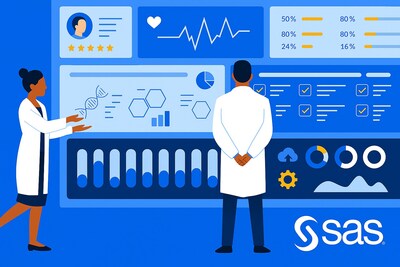
This year's forecast is equal parts ambition and reality check: Data streams finally harmonize, quantum models crash the preclinical party, regulatory sandboxes open for business and AI shows up everywhere – from clinical decisions to home health to the factory floor. The through line is clear: Leading organizations will treat data and AI as core infrastructure, not experimental add-ons.
Want to take a deeper dive? Register for the SAS webinar Top Health and Life Sciences Trends for 2026 on Jan. 22, 2026.
SAS 2026 predictions for health care and life sciences
Data orchestration harmonizes life sciences. As life sciences moves toward personalized medicine, we are no longer dealing with isolated data points. Instead, in 2026 and beyond we will orchestrate high-quality, continuous data streams from digital biomarkers, genomics, imaging and clinical laboratories. The promise of multimodal analysis – from genome-wide association studies to polygenic risk scores – depends on robust data engineering that can harmonize and contextualize these complex signals. Expect to see significant investment in the joining of the discovery and clinical analytical data fields.
– Dr. Mark Lambrecht, Global Head of Health Care & Life Sciences
Augmented intelligence unlocks the next era of rural care. AI will become the main driver of rural health access as virtual agents handle triage, care navigation and ongoing monitoring. Hybrid care teams will use AI tools that enhance human decision making by interpreting diagnostics, highlighting risks and guiding clinicians to the best next step. Value-based programs will shift toward predictive, AI-informed population management, while community resources such as transportation, food access and maternal support will be coordinated by intelligent agents that match services to patient needs at scale.
– Amanda Barefoot, Head, Global Health Care & Life Sciences Strategic Advisory
Quantum leaps into clinical research. Quantum machine learning (QML) will be successfully applied to the predictive toxicology of novel drug candidates in 2026. By simulating complex quantum mechanical effects with unprecedented accuracy, these models will flag potential safety issues earlier than classical AI, substantially reducing the failure rate in preclinical research.
– Brittany Shriver, Head, Global Life Sciences Strategic Advisory
Rise of in-home care programs spur tech innovation. In 2026, home health spending is expected to rise as hospital-at-home programs gain momentum and demand for in-home and community-based care continues to grow. Remote patient monitoring will become increasingly essential and will leverage IoT devices, event stream processing and AI to deliver real-time insights that help manage chronic conditions, improve outcomes and reduce costs. While the industry is still in the early stages of this transformation, more demonstration projects will emerge to validate the benefits and support the shift toward decentralized, data-driven care.
– Heather Hallett, RN, Head, US Health Care Strategic Advisory
Regulatory sandboxes accelerate health innovation. Hospitals, health organizations and startups will use regulatory-approved sandboxes with synthetic clinical data to test AI models, simulate clinical trials, prototype decision-support tools and accelerate validation process – without breaching privacy laws or health care regulations.
– Christian Hardahl, Head, EMEA Health Care Strategic Advisory
AI productivity stacks become the norm. By the end of 2026, every major enterprise will have an AI productivity stack. The same way every business today has cloud and customer relationship management (CRM), LLMs stitched into deterministic engines will run everything from marketing copy to medical billing. Generative AI gets the headlines, but deterministic AI writes the checks. Together they make the modern enterprise faster, leaner, and more inhumanly efficient. The losers will be clinging to the illusion that AI is another "tech wave."
– Heather Trimble, Health Care Strategic Advisor
Multimodal RWD becomes the rule, not the exception. Leveraging multimodal data is rapidly becoming standard practice in real-world evidence generation, providing a better understanding of patient populations by seamlessly integrating structured electronic medical record data, unstructured clinical progress notes, medical imaging, wearables, patient-reported outcomes, genomics and social determinants of health. The evolution of LLMs will finally solve decades-old interoperability challenges by speeding the data standardization process or even the direct understanding of the heterogeneous data sources.
– William Kuan, Health Care and Life Sciences Strategic Advisor
AI technology boosts pharma manufacturing. The pharmaceutical supply chain will be more digitally integrated and resilient to handle disruptions like pandemics, geopolitical shifts and raw material shortages. AI and machine learning will support predictive maintenance, real-time process monitoring and automated quality assurance, while emerging technologies like digital twins for real-time simulation and optimization and blockchain for traceability and compliance are tapped.
– Sharon Napier, Life Sciences Strategic Advisor
Clinical decisions get an AI boost. In 2026, health care will see accelerated adoption of AI-enabled clinical decision support systems, driven by their proven ability to enhance diagnostic precision and personalize therapeutic recommendations. This shift is underpinned by growing clinical trust, improved data interoperability and strategic investments highlighted in recent industry analyses.
– Dr. Mark Wolff, Health Care and Life Sciences Strategic Advisor
AI drives personalized medicine and patient care optimization. In 2026, AI models will be tapped to analyze patient genomics, history and treatment data to recommend optimal therapies or clinical trial participation. The use of AI to model molecular interactions, screen drug candidates and predict toxicity will reduce time and cost in early-stage discovery.
– Pritesh Desai, Life Sciences Strategic Advisor
Copilots and agents step up. In 2026, there will be a shift from the use of copilots as only code assistants to take on automation of manual tasks and accelerate drug submission approvals. Meanwhile AI agents take on a bigger role in 2026, but humans will still be engaged to validate and approve agent output. In Europe, the EU AI Act will refine human ownership on the overall process.
– Olivier Bouchard, Life Sciences Strategic Advisor
Data quality defines the future of health care success. As artificial intelligence continues to transform health care, a clear truth is emerging: The success of AI doesn't depend on the algorithms alone, it depends on the data that fuels them. In the era of predictive health and precision medicine, organizations that can access high-quality, patient-centric data and integrate it seamlessly across workflows will lead the way in delivering value, improving outcomes and earning consumer trust.
– Grace Gu, Health Care Strategic Advisor
Benefits (and risks) from health digitalization continue. Improvements in health care, health behaviors, medical research and clinical development – especially the application of AI and machine learning – have been made possible by the digitization of health care data. With those same benefits come additional risks to privacy and misuse of data. In 2026, we'll see investments in ensuring AI benefits while limiting the risks.
– Robert Collins, Health Care & Life Sciences Strategic Advisor
AI becomes ubiquitous, from marketing and administrative workflows to remote diagnostics. In 2026, machine learning and cloud-native platforms will be central to life sciences R&D, minimizing clinical trial failures and accelerating regulatory approvals. AI-driven drug discovery will shorten timelines for identifying viable drug candidates, while decentralized trials will play a pivotal role in reshaping study design and patient access. This transformation will elevate the strategic importance of data governance, model transparency and regulatory harmonization across the industry.
– Soundarya Palanisamy,Life Sciences Strategic Advisor
AI starts to bear fruit in sustainability. Expect a meaningful shift in health care and life sciences sustainability from reporting and data collection to practical changes driven by AI in areas like optimization and predictive logistics. In parallel, the environmental impact of AI will come under more scrutiny and will start to be a factor in procurement decisions, along with the broader supply chain footprint.
– Lisa Murch, Life Sciences Strategic Advisor
Learn more about SAS' analytics and AI solutions for health care (sas.com/healthcare) and life sciences (sas.com/lifesciences).
About SAS
SAS is a global leader in data and AI. With SAS software and industry-specific solutions, organizations transform data into trusted decisions. SAS gives you THE POWER TO KNOW®.
SAS and all other SAS Institute Inc. product or service names are registered trademarks or trademarks of SAS Institute Inc. in the USA and other countries. ® indicates USA registration. Other brand and product names are trademarks of their respective companies. Copyright © 2025 SAS Institute Inc. All rights reserved.
Editorial Contact:
Jennifer James
Jennifer.James@sas.com
919-531-0858
sas.com/news
 View original content to download multimedia:https://www.prnewswire.com/news-releases/health-and-life-sciences-in-2026-data-earns-its-doctorate-and-ai-prescribes-the-future-of-care-302638519.html
SOURCE SAS