


AI Comes of Age: Deloitte's 17th Annual Tech Trends Report Reveals How Leading Organizations Are Scaling AI for Outcomes and Impact
Five trends backed by real-world case studies and expert insights reveal why some organizations are stuck in pilot mode — and how to break through
NEW YORK, Dec. 10, 2025 /PRNewswire/ --

Key takeaways
- AI moves from experimentation to impact: Winners aren't layering onto broken processes; they're rebuilding operations from the ground up with focused, measurable results. The gap between those who reimagine work and those limited to rote automation is widening.
- AI is reshaping the tech organization, not replacing it: As AI is driving convergence across traditional back office, front office and product/digital offerings, the tech function is evolving from service delivery to strategic leadership with new capabilities and operating models.
- Five major trends are reshaping the enterprise: The report examines how to prepare for a hybrid human and silicon workforce, the rise of physical AI and robotics, the AI-first infrastructure reckoning, how tech organizations are being rebuilt, and the paradox of AI in enterprise security.
Why this matters
The technology landscape has fundamentally shifted, and with it comes a massive opportunity. AI is challenging boards, leaders and the workforce to rethink how they operate, compete and create value — and the organizations bold enough to rebuild rather than just enhance will define the next decade.
Enterprises are also faced with a variety of challenges, including economic uncertainty, policy shifts, and more, making it more important than ever to invest in strategic, scalable and transformational innovation. However, the complexity of creating an interconnected organization can be daunting and knowing where to invest can be difficult to pinpoint.
Ultimately, the gap between experimentation and impact is where competitive advantage is won or lost. Those who bridge it now are better positioned to shape their industries.
Key quotes
"The pace of technology change can be overwhelming. Deloitte's Tech Trends report aims to cut through hype to provide clarity and confidence about the business and mission impact expected over the next 18 to 24 months, with breadcrumbs to the real investments leaders can make today. While AI remains central, other advances — like human + machine dynamics, underlying infrastructure choices and the next wave of cyber — demand attention. Leaders can't afford inertia; 'Tech Trends' highlights real ways to forge new futures across industries worldwide."
- Bill Briggs, chief technology officer, Deloitte
"For 17 years, 'Tech Trends' has tracked emerging technologies poised to reshape business. This year is different. Innovation is compounding. Forces aren't simply additive, but multiplicative. Better technology enables more applications. More applications generate more data. More data attracts more investment. More investment builds better infrastructure. Each improvement simultaneously accelerates all the others. We're seeing the S-curves compress in real time, and the distance between emerging and mainstream is collapsing. That's the reality technology leaders are navigating."
- Kelly Raskovich, emerging technology leader and Tech Trends executive editor, Deloitte
The report identifies five interconnected forces reshaping enterprise technology. Each represents a shift from last year's experimentation phase to this year's scaling imperative:
AI-enabled robots: Intelligent robots enter human spaces as AI moves from screens to streets
As AI is integrated directly into physical forms, real world autonomous devices with unprecedented capability may soon navigate human spaces. AI will likely transition robots from niche, pre-programmed, task-specific tools to adaptive systems that can actively observe, decide, act, learn and adapt in dynamic settings. Success requires collaboration between hardware providers, regulatory bodies, and enterprises to turn these systems into reimagined work, not just next-gen tools.
AI agents: To give an AI agent a performance review, you'll have to rewrite the standards
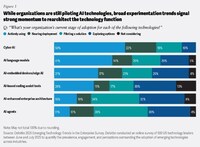
Despite enthusiasm for AI agents that can autonomously make decisions and complete tasks, many organizations are hitting a wall: only 11% have successfully deployed these systems in production. The challenge isn't technology, it's that enterprises are trying to automate existing processes designed for humans rather than redesigning them for AI-first operations. Leading organizations are reimagining what work means, based on the recognition that AI agents and human workers have different skill sets. Leaders are already beginning to develop hybrid human-digital workforces and investing to shepherd the massive change as teams and orgs increasingly are a mix of human and machine. Getting this balance right requires not just investing in learning, culture and growth for the human workforce, but also setting the foundation for the HR equivalent for advanced agents, robots and more.
AI infrastructure: AI sparked an infrastructure reckoning, now enterprises must build something new
While AI processing costs have plummeted, some organizations are seeing massive monthly bills. The culprit? Usage is growing far faster than costs are falling, and systems are built on top of aging infrastructure made for a different world. Organizations are hitting a tipping point where cloud services become cost-prohibitive for high-volume workloads. Leading organizations are implementing three-tier hybrid architectures: cloud for elasticity, on-premises for consistency, and edge for immediacy. In some cases, purpose-built AI data centers can be deployed faster than existing infrastructure can be retrofitted.
IT operating model: From architecture to delivery, AI flips the script on modern tech operations
AI is rewiring the ways IT organizations operate. What started out as a tool in the hands of the IT function is now reshaping it, and the familiar incremental pace of change is a thing of the past. A tech operation driven by AI can be leaner, faster and more adaptive, but for that to happen, tech leaders will need to pave the way with refreshed approaches to organization and culture. Leading organizations are anchoring AI initiatives to measurable business outcomes, designing modular architectures for flexibility, and redefining talent strategies around human-machine collaboration. Done right, these teams are the lighthouse that guides enterprise-wide transformation.
AI's cyber paradox: AI introduces new security vulnerabilities, but it's at the core of a proactive approach to emerging risks
AI is completely changing enterprise cybersecurity: The same technology that can deliver competitive advantage and new business opportunities is also introducing new cyber vulnerabilities and widening attack surfaces. Shadow AI deployments, adversarial attacks, and intrinsic system weaknesses are expanding attack surfaces. But the opportunity is using AI defensively, including red teaming with AI agents, adversarial training, and automated threat detection operating at machine speed. By adopting an "AI for cyber" and "cyber for AI" approach with security blueprints at its core, cyber leaders can proactively address emerging risks and drive tangible business outcomes.
Signals: The future is calling: Beyond the five major trends, Deloitte's report identifies eight emerging technology signals (or technology patterns) that forward-thinking leaders should monitor, including brain-inspired neuromorphic chips, edge AI applications, biometric authentication advances, how AI agents are reshaping privacy concerns, and generative engine optimization.
The 17th annual "Deloitte Tech Trends Report" tracks the important changes business and technology leaders can use to find opportunities for growth, innovation and market disruption.
Learn more about emerging technology at Deloitte and connect with us on LinkedIn.
About Deloitte
Deloitte provides industry-leading audit, consulting, tax and advisory services to many of the world's most admired brands, including nearly 90% of the Fortune 500® and more than 9,000 U.S.-based private companies. At Deloitte, we strive to live our purpose of making an impact that matters for our people, clients, and communities. We bring together distinct talents, technologies, disciplines, and an ecosystem of alliances to help tackle today's most complex business challenges and drive long-term progress. Deloitte is proud to be part of the largest global professional services network serving our clients in the markets that are most important to them. Bringing more than 180 years of service, our network of member firms spans more than 150 countries and territories. Learn how Deloitte's approximately 470,000 people worldwide connect for impact at www.deloitte.com.
Deloitte refers to one or more of Deloitte Touche Tohmatsu Limited, a UK private company limited by guarantee ("DTTL"), its network of member firms, and their related entities. DTTL and each of its member firms are legally separate and independent entities. DTTL (also referred to as "Deloitte Global") does not provide services to clients. In the United States, Deloitte refers to one or more of the US member firms of DTTL, their related entities that operate using the "Deloitte" name in the United States and their respective affiliates. Certain services may not be available to attest clients under the rules and regulations of public accounting. Please see www.deloitte.com/about to learn more about our global network of member firms.

 View original content to download multimedia:https://www.prnewswire.com/news-releases/ai-comes-of-age-deloittes-17th-annual-tech-trends-report-reveals-how-leading-organizations-are-scaling-ai-for-outcomes-and-impact-302637130.html
SOURCE Deloitte LLP