


RemotiveLabs cracks automotive's late-integration trap - and enabling China speed
LAS VEGAS, Jan. 8, 2026 /PRNewswire/ -- Every legacy automaker faces the same painful truth: the biggest delays and cost overruns rarely come from writing software. They come from discovering – far too late – how systems actually interact across domains, hardware, and software. When multi-ECU features, central compute logic, and HMI flows finally meet on hardware – often 12–18 months before SOP – teams enter "integration hell," losing predictability, momentum, and control.
At CES 2026, RemotiveLabs shows that this cycle is no longer inevitable. The company enables integration testing to be up to 10× faster than traditional hardware-based setups, as proven in customer studies. Teams can validate system behavior continuously from day one, without waiting for hardware or other teams' deliverables. Developers work against a fully virtualized system immediately, exposing interface-level issues earlier and progressing without blocking or destabilizing parallel work.
A shared virtual environment for continuous integration
RemotiveTopology is a shared virtual environment where E/E topologies are virtualized. ECUs, zonal controllers, and central compute units are connected using industry-standard communication protocols (CAN, LIN, Ethernet, etc.) and can be tested from day one. Software coexists with available hardware as if running in the real vehicle: Android Automotive, behavioral models, FMUs, test equipment, production code, and physical hardware can be mixed seamlessly. If a more detailed model or real unit becomes available, it can be plugged in without rework. RemotiveTopology is fully flexible, as once a unit is available in hardware, it can be seamlessly connected, thereby unlocking continuous improvement in automotive software and E/E development.
Instead of waterfall handovers, teams collaborate around a single source of truth. Integration becomes a continuous activity, not a late-stage event. Entry barriers are minimal since RemotiveTopology fits into existing tools and processes - from developer laptops to CI pipelines and hardware rigs.
The result is a practical path to China speed: shorter loops, earlier insights, fewer surprises, and a stable, transparent software baseline much earlier in the program. Issues that previously surfaced in year three now appear in week one. Integration cycles shrink from months to hours, giving teams the predictability needed to deliver on time, in budget, and with well-tested quality for SOP.
10x faster end-to-end integration testing compared to hardware rigs
Customer studies show that system-level validation in a virtual environment can be an order of magnitude faster than relying on hardware rigs. Teams often wait weeks just to access physical setups. With RemotiveTopology, developers can run multi-ECU end-to-end tests and get feedback in minutes instead of hours or days spent preparing their test on a hardware rig.
This acceleration is not just technical. It fundamentally changes how teams collaborate and take ownership. Integration testing becomes routine and observable rather than crisis-driven, enabling steady progress instead of late-stage firefighting. Explore use cases of RemotiveLabs tooling: www.remotivelabs.com/categories/use-case
RemotiveLabs hybrid vehicle topology demo at CES 2026
This year's RemotiveTopology demo shows what China speed looks like in practice: developers working as if the full vehicle is available from day one. RemotiveLabs demonstrates Android Automotive (AAOS in Cuttlefish) running together with a fully virtual vehicle in a simulated environment that provides sensor/actuator behavior, supported by helpful visualizations and full signal introspection.
This setup provides continuous insight into cross-domain behavior and integration status, making progress visible and actionable across teams – not just fast, but stable and predictable.
Visitors will also see how easy it is to get started: RemotiveLabs offers an open-source simplified vehicle on GitHub that anyone can run in minutes ("git clone, docker compose"), and then scale up from there by adding real hardware, production code, recordings with video sequences, and more, depending on the needs for the use case. The demo itself is a practical proof that early virtual integration testing on system level is no longer theoretical in automotive - it's accessible, realistic, and ready to fit into existing workflows. Explore RemotiveLabs on GitHub: https://github.com/remotivelabs
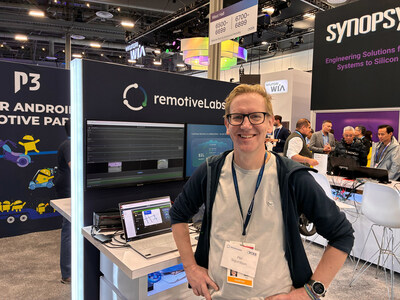
"Our customers virtualize entire E/E platforms, accelerate feedback loops, and run platform-level integration tests against production protocols directly in CI pipelines. This is the infrastructure that finally enables the development speed the SDV era demands," says Per Sigurdson, CEO & Co-Founder of RemotiveLabs.
About RemotiveLabs
RemotiveLabs provides an open, developer-centric collaboration and simulation environment that accelerates validation of multi-ECU, zonal, and central-compute E/E topologies – from simple restbus simulation for ECU development to full system-level integration. By enabling early system-level development, hybrid SIL/HIL workflows, and seamless integration with existing tools and organizations, RemotiveLabs helps automotive teams reduce risk and achieve a smoother, more predictable path to SOP. RemotiveLabs runs on AWS and GCP and is used by development teams at OEMs, Tier-1s, and automotive tech companies. Read more: https://remotivelabs.com
Photo: https://mma.prnewswire.com/media/2857491/Per_Sigurdson.jpg
 View original content:https://www.prnewswire.co.uk/news-releases/remotivelabs-cracks-automotives-late-integration-trap---and-enabling-china-speed-302656500.html