


NRMP Celebrates Results for the 2025 Medicine and Pediatric Specialties Match
WASHINGTON, Dec. 3, 2025 /PRNewswire/ -- The National Resident Matching Program® (NRMP®) is pleased to celebrate Match Day for the 2025 Medicine and Pediatric Specialties Match. This year, 8,526 resident physicians matched to fellowship training programs for the 2026 appointment year.
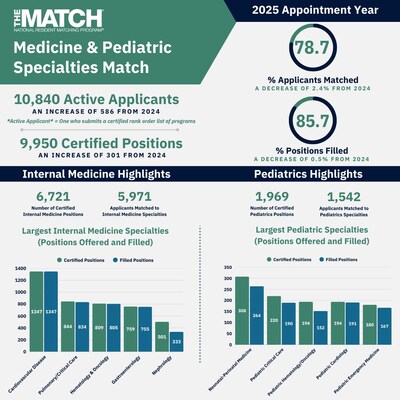
The Medicine and Pediatric Specialties Match is the largest of the 22 Fellowship matches managed by the NRMP as part of its Specialties Matching Service® (SMS®). This year, the Match encompassed 40 subspecialties in Internal Medicine and Pediatrics along with Addiction and other multidisciplinary subspecialties. There were 3,777 program tracks that submitted certified rank order lists, an increase of 68 from 2024. Those programs collectively offered 9,950 positions, an increase of 301 over last year, of which 8,526 (85.7 percent) were filled. The number of active applicants (those who submitted rank order lists for the Match) totaled 10,840, an increase of 586 compared to last year, with 8,526 matching to training, an increase of 213 from 2024.
"The 2025 Medicine and Pediatric Specialties Match underscores continued interest in and importance of subspecialty training in meeting the complex health care needs of patients nationwide," said Donna L. Lamb, DHSc, MBA, BSN, NRMP President and CEO. "With growth noted in both program and applicant participation, it is clear the graduate medical education community values NRMP's Specialties Matching Service as a means of offering and securing highly specialized training opportunities that align physician interests with community needs."
Highlights for Specialties
The Medicine and Pediatric Specialties Match routinely includes participation from a varied group of subspecialties and programs in Internal Medicine, Pediatrics, Addiction, and multidisciplinary fields.
- There were 18 Internal Medicine subspecialties included in this year's Match, with 2,296 program tracks offering 6,721 certified positions. Of the positions offered, 5,971 positions filled for an 88.8 percent fill rate reflecting a 1.0 percentage point decrease over last year. Subspecialties offering at least 150 certified positions and filling over 98 percent of positions include:
- Cardiovascular Disease (1,347 certified positions; 100 percent fill rate)
- Clinical Cardiac Electrophysiology (150 certified positions; 98 percent fill rate)
- Gastroenterology (759 certified positions; 99.5 percent fill rate)
- Hematology and Oncology (809 certified positions; 99.5 percent fill rate)
- Pulmonary/Critical Care (844 certified positions; 98.8 percent fill rate)
- Rheumatology (302 certified positions; 99.0 percent fill rate)
- Among the 17 Pediatric subspecialties in the Match, 925 programs offered 1,969 certified positions, of which 1,542 positions filled at 78.3 percent reflecting a 0.8 percentage point increase compared to last year. Because Pediatrics is a smaller specialty with fewer subspecialties offering a large number of certified positions, the criteria used to highlight subspecialties with high fill rates differ from Internal Medicine. For Pediatrics, subspecialties offering at least 100 certified positions and filling over 95 percent of positions include:
- Pediatric Cardiology (194 certified positions; 98.5 percent fill rate)
- Pediatric Gastroenterology (124 certified positions; 96.0 percent fill rate)
- The three multidisciplinary specialties (those that recognize completion of residency from a variety of specialties) included Allergy/Immunology, Hospice and Palliative Medicine, and Sleep Medicine. There were 403 program tracks offering 877 certified positions, of which 763 filled for an 87.0 percent fill rate reflecting a 0.4 percentage point decrease compared to last year. Allergy and Immunology offered 177 certified positions and achieved a 98.9 percent fill rate.
Highlights for Applicants
Of the active applicants in the 2025 Medicine and Pediatric Specialties Match, 78.7 percent successfully matched to a position. While this match rate reflects a 2.4 percentage point decrease compared to last year, applicant participation this year grew by 5.7 percent, underscoring the expanding reach and increasing competitiveness of the Match. Summary data for each of the primary applicant groups are included below:
- There were 4,618 graduates of MD medical schools in the Match, nine more than last year. Of those, 4,096 (89 percent) matched to a position, a decrease of 34 from 2024.
- There were 1,728 graduates of DO medical schools, 187 more than last year. Of those, 1,351 (78 percent) matched to a position, an increase of 133 from 2024.
- There were 1,593 U.S. citizen international medical graduates (IMGs), 41 more than last year. Of those, 1,038 (65 percent) matched to a position, a decrease of four from 2024.
- There were 2,892 non-U.S. citizen IMGs in the Match, 359 more than last year. Of those, 2,033 (70 percent) matched to a position, an increase of 128 from 2024.
Combined Matches like the Medicine and Pediatric Specialties Match provide flexibility for applicants to consider and rank a variety of subspecialties on a single rank order list. They also allow applicants who elect to participate in the Match as a couple better align their training preferences and increase the likelihood of securing their program(s) of choice. Couples participation in the Medicine and Pediatrics Match has been relatively consistent: this year, 129 couples certified a rank order list compared to 140 couples in 2024 and 139 couples in 2023.
Notable Trends
- MD graduates remain the most frequently matched applicant group. MD graduates accounted for 48 percent of matches overall and 43.9 percent of matches in all Internal Medicine specialties, 58.7 percent in all Pediatric specialties, 54.4 percent in all multidisciplinary specialties, and 62.4 percent in all Addiction specialties.
- Non-U.S. IMGs were the second most frequently matched applicant group in all Internal Medicine specialties, representing 28.4 percent. DO graduates represented the second most matched applicant group in all Pediatrics specialties (17.5 percent), all multidisciplinary specialties (20.7 percent), and all Addiction specialties (16 percent).
- The decreasing fill rate in Adult Infectious Disease has been in the spotlight since the COVID pandemic. The specialty reached a position fill rate of 87.7 percent in 2020, the highest in the last ten years, but has seen steady decreases save for a small rebound in 2024. For the 2025 Match year, Adult Infectious Disease filled at 60.9 percent, a decrease of 9.3 percentage points.
- With a national aging population, performance of and interest in subspecialties that cater to the needs of older adults can be insightful. As an example, program outcomes in Geriatric Medicine have vacillated in recent years. While the number of certified positions offered in 2025 (n=388) was an increase of six positions over the prior year, the number remains lower than those offered between 2021 and 2023. Moreover, fill rates for Geriatric Medicine have hovered between 41 and 51 percent over the past four years. This year the fill rate declined to 37 percent.
- Outcomes for the two Addiction subspecialties also have vacillated: Addiction Medicine saw an increase of seven program tracks and 37 positions in the Match, but the fill rate declined by nearly three percentage points, from 66.7 to 63.8 percent. In contrast, Addiction Psychiatry saw a modest increase of six programs and eight positions over last year, but the fill rate increased notably from 58.7 to 68.8 percent, the highest since the subspecialty joined the Match for the 2023 appointment year.
View the 2025 Medicine and Pediatric Specialties Match Statistics Report and infographic for additional data.
About the Medicine and Pediatric Specialties Match
The 2025 Medicine and Pediatric Specialties Match includes 18 Internal Medicine subspecialties, 17 Pediatric subspecialties, two Addiction subspecialties, and three multidisciplinary subspecialties and is part of NRMP's Specialties Matching Service®. The unified Medicine and Pediatric Specialties Match allows applicants greater flexibility in pursuing training and also offers institutions greater efficiency by maintaining a shared Match timeline across a multitude of subspecialties.
About NRMP
The National Resident Matching Program® (NRMP®) is a private, non-profit organization established in 1953 at the request of medical students to provide an orderly and fair mechanism for matching the preferences of applicants for U.S. residency positions with the preferences of residency program directors. In addition to the annual Main Residency Match® that facilitates placement for more than 50,000 registrants, the NRMP conducts Fellowship Matches through its Specialties Matching Service® (SMS®). The first SMS Fellowship Match was conducted in 1984 for Colon and Rectal Surgery. Since that time, the SMS has grown to encompass 22 separate Matches representing more than 75 subspecialties. The NRMP website provides a list of participating SMS Fellowship Matches, each including a summary statement, length of training, and applicant eligibility criteria
For additional information or to schedule an interview with NRMP President and CEO Donna L. Lamb, DHSc, MBA, BSN, contact media@nrmp.org.
 View original content to download multimedia:https://www.prnewswire.com/news-releases/nrmp-celebrates-results-for-the-2025-medicine-and-pediatric-specialties-match-302632092.html
SOURCE National Resident Matching Program