


The Year AI Became Operational: Best of 2025 Report from Info-Tech Research Group Reveals How IT Leaders Embedded Intelligence Across the Enterprise
With organizations moving from AI experimentation to enterprise-wide adoption in 2025, IT leaders are facing rising pressure to embed intelligence across strategy, operations, and delivery. New findings from global research and advisory firm Info-Tech Research Group show that while AI has become operational across every layer of IT, leaders have also accelerated investments in data quality, governance, operating models, and architecture to support sustainable scale. The firm's Best of 2025 report highlights the top research, tools, and playbooks that CIOs relied on most as they worked to operationalize AI and strengthen the foundations required for long-term success.
ARLINGTON, Va., Dec. 10, 2025 /CNW/ - As AI adoption advanced from concept to full operational integration in 2025, IT leaders faced a new reality. Artificial intelligence was no longer a discrete project or isolated pilot. It became a core design principle for strategy, service delivery, and department-wide decision-making. According to newly published insights from Info-Tech Research Group, this shift has created significant demand for frameworks, roadmaps, and tools that help IT leaders mature the foundations needed to scale AI responsibly and effectively. The global IT research and advisory firm's Best of 2025 report captures the year's most accessed research and resources and provides a clear view of how organizations translated AI ambition into real operational outcomes.
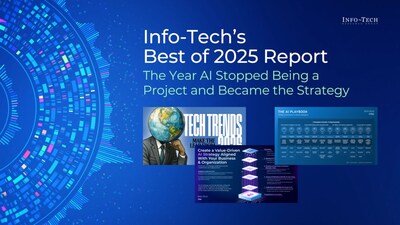
Info-Tech's Best of 2025 findings reveal that while AI topped the strategic agenda, CIOs simultaneously doubled down on fundamentals. Data strategy and data quality, enterprise architecture, service management, operating models, governance, and risk management all saw high demand as leaders prepared their environments for agentic AI, automation, and intelligence-driven workflows. The report shows that organizations focused less on experimentation and more on embedding AI into core processes that influence productivity, decision-making, and operational continuity.
"AI delivered real impact only when organizations paired experimentation with disciplined foundations," says Info-Tech Research Group's Chief Research Officer, Gord Harrison. "IT leaders have more challenges turning intelligence into meaningful outcomes when they lack clarity in data ownership, sound architectural structure, and aligned governance. Info-Tech's Best of 2025 report shows that the organizations advancing fastest were the ones strengthening these core fundamentals, from data and architecture to operating models and governance, as they embedded AI into the everyday fabric of IT."
Key Challenges Slowing AI at Scale
Despite widespread adoption, organizations continue to encounter systemic barriers that hinder AI's full operational potential. Info-Tech's report highlights several challenges that shaped IT priorities in 2025:
- Fragmented data practices that weaken model accuracy and decision-making
- Operating models that do not reflect the speed or structure required for AI-driven delivery
- Gaps in governance and risk management that create uncertainty and stall progress
- Legacy service management processes that limit automation opportunities
- Skill shortages that constrain the ability to scale agentic and advanced AI capabilities
Info-Tech's Top Research for 2025
To address these challenges, Info-Tech's Best of 2025 report outlines the resources that CIOs relied on most to operationalize AI and reinforce IT foundations. These include:
- Operationalizing AI Across the Enterprise:
CIOs turned to resources such as Build Your AI Strategy and Roadmap, The AI Playbook, and Build Your Agentic AI Prototype as they shifted from pilot projects to embedded AI capabilities. These tools helped IT leaders align AI investments with business goals, build agentic models, and integrate intelligence into everyday operations. - Reinforcing Data Foundations for Scalable AI:
AI-driven decision-making increased demand for core data frameworks. Popular resources included Build a Robust and Comprehensive Data Strategy, Establish the Target Operating Model Needed to Execute Your Data Strategy, and Build Your Data Quality Program. These blueprints guided leaders in strengthening governance, improving data health, and ensuring that models are fueled by high-quality information. - Modernizing Core IT Architecture and Operating Models:
As AI adoption accelerated, organizations required more adaptable and integrated foundations. High-demand research, such as Build Your EA Practice Strategy, The Enterprise Architecture Playbook, and Achieve IT Spend and Staffing Transparency, helped CIOs redesign operating structures, manage complexity, and align enterprise architecture with evolving priorities. - Advancing IT Service Delivery Through Automation and Efficiency:
The push to operationalize intelligence placed new emphasis on service desk modernization and automated workflows. Resources like Standardize the Service Desk, Implement an AI-Orchestrated Service Desk, and concierge services such as Exploit Your ITSM Ticket Data enabled teams to improve performance, reduce manual work, and prepare ITSM ecosystems for agent-driven support. - Strengthening Governance, Controls, and Responsible AI Practices:
The speed of AI adoption brought increased scrutiny to risk, compliance, and security. Leaders turned to tools such as Build Your AI Risk Management Roadmap, Develop an AI Compliance Strategy, and Build an Effective IT Controls Register to manage emerging risks, align to global standards, and establish guardrails for safe, transparent, and reliable AI use.
The top priorities highlighted in the firm's resource reinforce a common pattern: AI became operational through a combination of intelligence and maturity, not intelligence alone.
The Best of 2025 report from Info-Tech Research Group includes detailed frameworks, playbooks, diagnostics, and advisory insights that reflect how IT leaders moved from AI experimentation to enterprise-scale implementation. By applying these research-backed tools, CIOs can strengthen data foundations, align architecture and operating models, integrate responsible AI practices, and ensure that intelligence becomes a durable, value-producing capability across the organization.
For exclusive and timely commentary from Info-Tech's subject matter experts on the report's findings, and access to the complete Info-Tech's Best of 2025 report, please contact pr@infotech.com.
About Info-Tech Research Group
Info-Tech Research Group is one of the world's leading and fastest-growing research and advisory firms, serving over 30,000 IT, HR, and marketing professionals around the globe. As a trusted product and service leader, the company delivers unbiased, highly relevant research and industry-leading advisory support to help leaders make strategic, timely, and well-informed decisions. For nearly 30 years, Info-Tech has partnered closely with teams to provide everything they need, from actionable tools to expert guidance, ensuring they deliver measurable results for their organizations.
To learn more about Info-Tech's HR research and advisory services, visit McLean & Company, and for data-driven software buying insights and vendor evaluations, visit the firm's SoftwareReviews platform.
Media professionals can register for unrestricted access to research across IT, HR, and software, and hundreds of industry analysts through the firm's Media Insiders program. To gain access, contact pr@infotech.com.
For information about Info-Tech Research Group or to access the latest research, visit infotech.com and connect via LinkedIn and X.

 View original content to download multimedia:https://www.prnewswire.com/news-releases/the-year-ai-became-operational-best-of-2025-report-from-info-tech-research-group-reveals-how-it-leaders-embedded-intelligence-across-the-enterprise-302638376.html
SOURCE Info-Tech Research Group