


UltraSense Systems Launches UltraTouch™ AR2 Interaction Platform, USG4000 Series, to Solve Capacitive Limits and Gesture Overload in AR Glasses
UltraSense working with major OEMs to deliver thinner and more fashionable frames with a more intuitive user experience
SAN JOSE, Calif., Dec. 10, 2025 /PRNewswire/ -- UltraSense Systems, a leader in ultrasound and multi-modal user interfaces, today announced its next-generation UltraTouch™ AR2 Interaction Platform, classified as the USG4000 Series, a high-integration HMI controller family created specifically for AR glasses. The platform combines ultrasound, capacitive, and force sensing to deliver reliable, intuitive controls across magnesium, titanium, and plastic frames, targeting the next wave of AI-powered AR wearables.
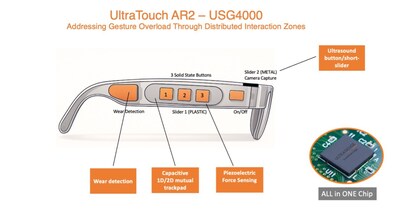
As AR glasses rapidly evolve into the next compute platform, OEMs are ramping programs that must manage display, media, calls, camera, and AI assistants in a tiny, fashion-critical form factor. First-generation products leaned heavily on simple capacitive strips but that approach is now running into hard limits.
Capacitive Alone Can't Scale to the Next AR Generation
- Unreliable in the real world – Pure capacitive sensing may have been acceptable for early AR devices, but it struggles in high-volume, high-quality products. Wet hair, sweat, and incidental contact routinely create false triggers and poor user experience.
- Gesture overload on one pad – As LCOS and MicroLED displays roll out, UI requirements explode. Trying to run display, media, calls, and camera through complex multi-finger gestures on a single 2D capacitive pad is unrealistic and not intuitive for mainstream users.
- No solution for metal frames – Today's capacitive-only solutions cannot support magnesium and titanium frames, blocking the premium, fashionable designs consumers expect.
UltraTouch AR2 / USG4000: Multi-Modal, Not Multi-Finger
UltraSense addresses these issues with a multi-modal, 1D zone-based architecture rather than overloading one 2D pad:
- CapForce™ with Force Fusion – A co-polymer layer adds force sensing to capacitive, dramatically reducing false triggers from wet hair and sweat while adding minimal thickness and enabling retrofit designs.
- UltraForce™ for metal, CapForce™ for plastic – Ultrasound-based UltraForce enables seamless interaction in magnesium and titanium; CapForce covers plastic temples. Both support soft buttons, sliders, and press depth.
- Functional zones, like a phone layout – Different regions of the frame are dedicated to different jobs:
- Calls (accept / end / reject, volume ±) via metal slider + tactile button at the tip of the frame (UltraForce)
- Camera (photo / video) via a short slider or tactile dome near the hinge or tip, with light vs hard press semantics
- Media & Display navigation (play/pause, skip, scroll, select, back) via side-temple slider or pad using CapForce or UltraForce
Each zone uses simple one-finger, 1D gestures—tap, swipe, short/long press, light vs firm press. Combining location, gesture type, and force level creates a rich command vocabulary without awkward multi-finger chords. This lowers gesture load, improves discoverability, and boosts reliability. The platform also supports wear on/off detection and anticipates auxiliary devices like rings or wristbands for even richer control.
"All of the big issues in AR glasses converge on one challenge: how to deliver a simple, reliable user experience while the system gets more capable, the frames get thinner, and materials shift to magnesium and titanium," said Mo Maghsoudnia, CEO of UltraSense Systems. "With UltraTouch AR2 and the USG4000 Series, we move beyond capacitive-only thinking. By fusing ultrasound, capacitive, and force in one material-agnostic chip, we solve false triggering, eliminate gesture overload, and enable truly fashionable AR glasses that people will want to wear every day."
The USG4000 Series HMI controller can power all UI functions—side sliders, virtual on/off, camera shutter, volume, media, and display control—on both metal and plastic frames, delivering one chip for all AR UI. UltraSense's platform offers sub-5 mm thickness, ultra-low power operation, and a seamless industrial design path for next-generation AR devices.
About UltraSense Systems
UltraSense Systems is transforming human-machine interfaces through its proprietary ultrasound and piezoelectric sensing technologies. With deep semiconductor and systems expertise, UltraSense enables seamless, intuitive interactions on any surface—metal, glass, plastic, or fabric—across automotive, consumer, medical, and AR/VR applications.
Press Contact:
Nicole Conley
Tanis Communications
nicole.conley@taniscomm.com

 View original content to download multimedia:https://www.prnewswire.com/news-releases/ultrasense-systems-launches-ultratouch-ar2-interaction-platform-usg4000-series-to-solve-capacitive-limits-and-gesture-overload-in-ar-glasses-302637524.html
SOURCE UltraSense Systems