


CES 2026: Guangfan Technology Reveals Lightwear, Introducing World's First Vision-Enabled AI Earphones
LAS VEGAS, Jan. 7, 2026 /PRNewswire/ -- On January 6, AI-native wearable startup Guangfan Technology made its appearance at CES 2026 with the debut of Lightwear, a full-sensory wearable device that marks a significant step forward in the evolution of AI hardware. Positioned as the world's first proactive AI wearable to introduce visual perception into an earbud form factor, Lightwear represents a breakthrough not only in device design but also in how artificial intelligence perceives and responds to the real world.
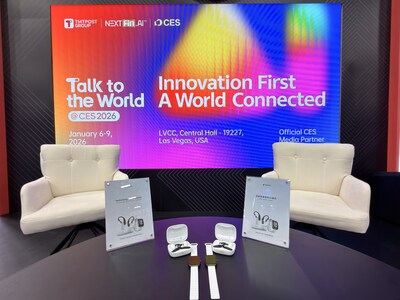
Unlike existing smart devices that rely primarily on voice commands or screen-based interaction, Lightwear enables AI to interpret physical environments through visual input and multimodal reasoning. By allowing AI to "see" as well as "hear," the device shifts interaction from passive command-response toward proactive, context-aware assistance, moving beyond understanding instructions to understanding situations.
"The arrival of AI is reaching a moment where science fiction is beginning to materialize," said Dong Hongguang, founder of Guangfan Technology. However, he emphasized that ideal AI hardware should not simply be an extension of smartphones or glasses. Lightwear was conceived as a standalone AI assistant built around three principles: full perception, all-day availability, and proactive intelligence. The goal, he noted, is to let technology step back while placing human experience at the center.
From an industry perspective, Dong believes nearly every sector will be reshaped by AI, and hardware is no exception. While the ultimate form of AI hardware remains an open question, a growing consensus has emerged around three prerequisites for proactive intelligence: constant wearability, uninterrupted availability, and comprehensive sensory input. These ideas form the foundation of Lightwear's design logic.
Guangfan chose a combination of earphones and a smartwatch to meet these requirements. Wearable devices offer a level of constant presence that handheld products cannot, making them better suited as long-term AI interfaces. In Dong's view, future AI interaction points must be located near the head, where microphones, speakers, and cameras naturally converge. The smartwatch provides rich sensor data, while the earphones offer continuous access to audio and environmental signals, enabling a more comprehensive contextual analysis.
All-day readiness was another critical requirement. Lightwear is designed for long-duration, low-friction use, with extended battery life built directly into the earphones and a high-capacity charging case exceeding 2000mAh. The device supports independent connectivity, allowing it to operate without reliance on a smartphone. Notably, the charging case includes its own microphone and speaker, enabling voice interaction with AI even when the earphones are not worn.
Visual perception is what ultimately distinguishes Lightwear from existing AI wearables. Vision carries far more information density than audio alone, allowing AI to better interpret surroundings, user activities, and emotional context. Integrating a camera into an earbud, however, presented significant engineering challenges related to size, weight, heat dissipation, and comfort. According to on-site evaluations, Guangfan addressed these constraints through a balanced front-and-back weight distribution and a titanium ear-hook design. Even with the added camera and battery capacity, each earbud weighs only 11 grams, which is substantially lighter than most smart glasses, while maintaining comfortable, long-term wearability.
To enable proactive intelligence at the system level, Lightwear runs on Lightware OS, Guangfan's self-developed native AI operating system. By integrating hardware, models, and applications into a unified architecture, the OS enables multimodal interaction and real-time data fusion, forming the backbone of Lightwear's proactive AI capabilities.
Looking ahead, Guangfan plans to expand Lightware OS across additional wearable forms, including AI glasses, pendants, and neck-mounted devices, depending on supply chain readiness. The company also aims to build an open agent ecosystem, allowing third-party agents and external AI hardware to connect through standardized protocols, further enriching proactive services.
About Guangfan Technology
Guangfan Technology is a next-generation human-device interaction company focused on moving beyond app- and command-driven interfaces. By combining voice, vision, environmental context, and real-world perception, Guangfan's AI systems are designed to understand not only what users say, but what they see, experience, and intend. The company's mission is to develop intelligent devices and an open AgentOS that integrates seamlessly into everyday life. Within its first year, Guangfan has completed multiple funding rounds, backed by leading industry investors.
For more information, please visit https://guangfan.com/ or contact bd@guangfan.ai.
 View original content to download multimedia:https://www.prnewswire.com/news-releases/ces-2026-guangfan-technology-reveals-lightwear-introducing-worlds-first-vision-enabled-ai-earphones-302654775.html
SOURCE Beijing Guangfan Technology Co., Ltd.