


Deloitte: US Consumer Interest in Internal Combustion Engines Remains Steady Amid Affordability Concerns and Shifting Expectations Around Value
U.S. consumers balance interest in familiar powertrains with modest EV intent as brand loyalty softens and connected vehicle expectations evolve across the ownership journey
NEW YORK, Jan. 7, 2026 /PRNewswire/ --
Key takeaways
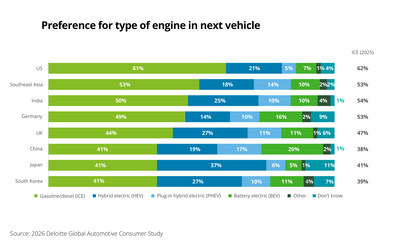
- In the U.S., interest in internal combustion (ICE) vehicles and hybrids (HEV/PHEV) is relatively flat, while BEV intent is up slightly year-over-year.
- Available driving range remains the top EV concern for U.S. consumers surveyed (47%), followed by charging time (44%) and overall cost (40%).
- Brand loyalty continues to wane, with 53% of U.S. consumers surveyed planning to choose a different brand for their next vehicle, driven primarily by product quality, performance and pricing considerations.
- More than half of U.S. survey respondents (52%) say they would keep their vehicle longer with regular over-the-air (OTA) updates, with 62% willing to pay above a vehicle's list price to gain access to the functionality.
- Security-oriented connected features, such as anti-theft tracking, resonate most with U.S. consumers, while concerns about data sharing, particularly personally identifiable data, remain high.
- Service interactions play an increasingly important role in shaping customer trust, with 57% of U.S. vehicle owners surveyed indicating they had their most recent service experience at a dealership, citing quality of work as the key driver.
Why this matters
The automotive industry is navigating one of the most transformative periods in its history amid shifting consumer expectations, advancing vehicle technologies, and new ownership dynamics. For 16 years, Deloitte has examined the consumer trends influencing the rapidly evolving global mobility ecosystem. This year's report, "2026 Global Automotive Consumer Study," explores powertrain preferences, future vehicle intentions, software-defined experiences, and servicing expectations at a moment when affordability concerns are leading many consumers to reconsider what truly defines value in mobility and what they expect from vehicle brands.
Affordability influences EV intent
U.S. consumers are balancing affordability with the realities of charging access and everyday use as they consider future vehicle choices. Persistent concerns around range, charging time and cost continue to temper BEV/PHEV adoption, signaling a cautious move toward electrification.
- Among U.S. surveyed consumers, purchase intent for ICE (61%) and hybrid electric vehicles (HEV/PHEV) (26%) is flat year-over-year, while BEV purchase intent has seen a modest increase, rising only 2 percentage points year-over-year to 7%.
- Among global respondents, BEV intention is highest among consumers in China (20%), along with hybrid intentions in Japan (43%), highlighting the difference in powertrain adoption across markets.
- Lowering fuel costs remains the top reason (52%) that U.S. consumers surveyed say they would consider an EV for their next vehicle purchase, reinforcing a strong desire to mitigate longstanding concerns around total cost of ownership.
- A majority of U.S. EV intenders surveyed plan to charge their vehicles at home (77%), yet over half (53%) report they currently do not have access to a dedicated home charger, underscoring a potential source of concern regarding associated installation costs.
- Available driving range remains the greatest BEV concern for U.S. consumers (47%), followed by time required to charge (44%) and overall cost (40%). Interestingly, safety concerns with battery technology is a growing concern among global respondents in South Korea (50%), India (38%) and China (32%).
Consumers rethink vehicle loyalty and value
Brand loyalty continues to evolve as consumers weigh fundamentals like price, performance and quality in their next vehicle decisions. In the U.S., surveyed consumers remain anchored by transparent pricing and the ability to evaluate vehicles in person, reinforcing the continued role of trusted dealer interactions in shaping the purchase experience.
- A majority of respondents surveyed plan to switch brands for their next vehicle: 53% of U.S. consumers surveyed plan to switch brands, and globally, switching intent is highest among consumers in China (72%) and India (70%).
- Product quality (58%), vehicle performance (51%), and price (46%) remain the top factors influencing U.S. consumers' choice of brand for their next vehicle.
- For U.S. consumers surveyed, the most important aspect of their next vehicle purchase experience centers around getting a good deal (62%), followed by transparent pricing (47%) and experiencing the vehicle in person (40%), reinforcing the role of dealership interactions in consumer purchasing experience.
- Preference for domestic over foreign brands is variable among U.S. consumers, with 46% indicating no brand origin preference, so long as the vehicle meets their needs. In contrast, respondents in Japan show the highest domestic brand affinity at 78%.
- Across many global markets, dealer visits and manufacturer websites remain leading research channels, with over half of German consumers (56%) and 47% of U.S. consumers relying on dealer interactions. Manufacturer websites are the top source in Japan (50%), while consumers in India (59%) and Southeast Asia (53%) turn to social media and influencer reviews when researching their next vehicle.
Key quote
"As the global industry advances toward software-defined vehicle platforms, continuous upgradability is becoming a powerful way to extend vehicle life and strengthen consumer loyalty. At the same time, it introduces a strategic dilemma: OTA updates enhance safety and performance and reduce warranty costs, yet they can also keep vehicles feeling newer for longer, potentially slowing future replacement cycles. In an environment marked by affordability pressures and limited willingness to pay for digital add-ons, automakers should consider how they deliver software-enabled value across the ownership lifecycle to support long-term growth."
— Jody Stidham, managing director, global automotive, Deloitte
SDVs generate mixed signals
As vehicles become more digitally enabled, U.S. consumers remain selective in the connected and software-defined features they value. Safety-oriented applications generate the strongest interest, while enthusiasm for OTA upgrades that extend the vehicle lifecycle is tempered by willingness to pay a premium for features that some expect to be included as standard.
- U.S. consumers surveyed show the highest willingness to pay for safety and security-related connected features, including anti-theft tracking (61%), pedestrian/vehicle detection (59%), and emergency assistance (58%).
- Data privacy within connected-vehicle systems remains a major concern for U.S. respondents, particularly around information from synced devices (62%), in-cabin camera data such as driver monitoring (58%), and vehicle location data (58%), underscoring rising sensitivities around personally identifiable information.
- Willingness to pay for enhanced over-the-air (OTA) functionality remains somewhat limited. Among U.S. consumers surveyed, 38% say they are not willing to pay anything extra and a further 28% are only willing to pay up to 5% above the vehicle's list price for automated updates that reduce workshop visits, suggesting OTAs may be viewed as a baseline expectation rather than a premium feature.
- More than half of U.S. consumers surveyed (52%) say they would keep their vehicle longer if it received regular OTA updates: 26% of U.S. consumers would keep their vehicle for an additional two to three years, with such updates opening the door for OEMs to strengthen brand loyalty through frequent digital engagement while reducing their reliance on hardware redesigns.
- Voice command support in local languages is seen as a crucial functionality among respondents in China (80%), India (80%) and Japan (70%), compared to only 43% of U.S. consumers, signaling regional differences in digital engagement expectations.
Trusting the service experience process
How and where a vehicle is serviced continues to shape trust, influencing the value consumers place on different service providers. While dealerships remain a familiar touchpoint for many, expectations around quality, clarity and communication suggest that service experiences play an increasingly meaningful role in how consumers view their ownership journey.
- A majority of U.S. consumers surveyed received their most recent vehicle service at an authorized dealership (57%), though independent repair facilities still represent a meaningful share of service visits (31%).
- Quality of work remains the top driver of service provider choice for U.S. consumers (20%).
- Transparency around pricing and the work performed is the most important aspect of a vehicle service experience, according to 24% of survey respondents.
- U.S. consumers report the highest trust in the dealership where they regularly service their vehicle (25%), followed by the dealership where they bought their vehicle (21%), underscoring the influence of dealer interactions in shaping long-term customer relationships.
Key quote
"The U.S. automotive sector is entering a critical phase defined by tightening affordability, evolving expectations around value, and a growing emphasis on longer-term ownership experiences. As new vehicle demand levels off, deeper collaboration between OEMs and dealers, particularly around servicing and the post-purchase journey, will be important to strengthening loyalty and sustaining engagement in a market where traditional growth levers are becoming harder to pull."
— Lisa Walker, vice chair and U.S. automotive sector leader, Deloitte
Deloitte's "2026 Global Automotive Consumer Study," is based on a survey of more than 28,000 consumers from 27 countries conducted from October through November 2025. For additional details and country-specifics, please visit the interactive dashboard.
About Deloitte
Deloitte provides industry-leading audit, consulting, tax, and advisory services to many of the world's most admired brands, including nearly 90% of the Fortune 500® and more than 9,000 U.S.-based private companies. At Deloitte, we strive to live our purpose of making an impact that matters for our people, clients, and communities. We bring together distinct talents, technologies, disciplines, and an ecosystem of alliances to help tackle today's most complex business challenges and drive long-term progress. Deloitte is proud to be part of the largest global professional services network serving our clients in the markets that are most important to them. Bringing more than 180 years of service, our network of member firms spans more than 150 countries and territories. Learn how Deloitte's approximately 470,000 people worldwide connect for impact at www.deloitte.com.
Deloitte refers to one or more of Deloitte Touche Tohmatsu Limited, a UK private company limited by guarantee ("DTTL"), its network of member firms, and their related entities. DTTL and each of its member firms are legally separate and independent entities. DTTL (also referred to as "Deloitte Global") does not provide services to clients. In the United States, Deloitte refers to one or more of the US member firms of DTTL, their related entities that operate using the "Deloitte" name in the United States, and their respective affiliates. Certain services may not be available to attest clients under the rules and regulations of public accounting. Please see www.deloitte.com/about to learn more about our global network of member firms.

 View original content to download multimedia:https://www.prnewswire.com/news-releases/deloitte-us-consumer-interest-in-internal-combustion-engines-remains-steady-amid-affordability-concerns-and-shifting-expectations-around-value-302654451.html
SOURCE Deloitte